
Author: Luna Jade – Global K-Beauty Brands in 10+ years for Market Analyst, discussing K-Beauty’s Global Surge.
The Global Spotlight on K-Beauty’s Global Surge
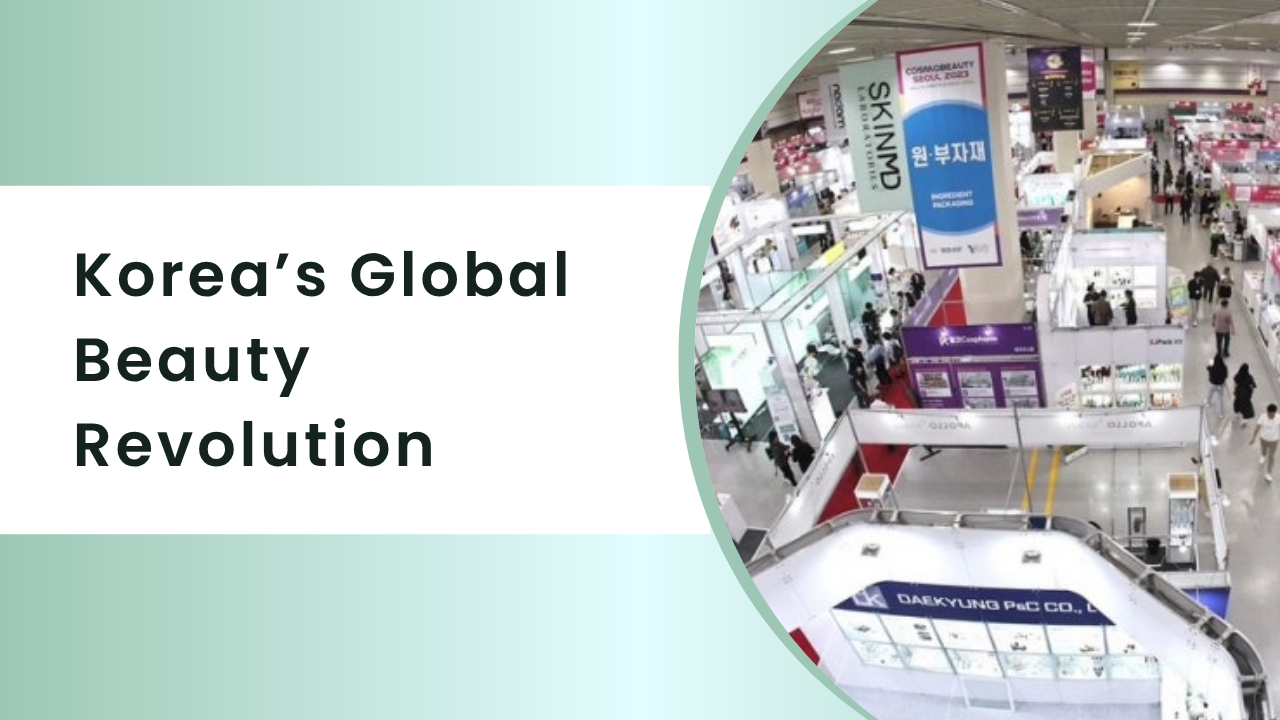
The Korean beauty industry—once considered a niche trend—is now a dominant global force. With a surge in demand from North America, Southeast Asia, and even the Middle East, K-beauty brands have gone from viral cult favorites to structured, data-driven export machines. One of the most telling indicators of this shift is the scale and international participation in the 2025 Seoul International Cosmetics & Beauty Industry Expo, which took place in May at COEX, Seoul.
With over 400 companies and thousands of global buyers in attendance, the expo was more than a showcase; it was a real-time barometer of trends, strategies, and cross-border skincare ambitions.
“K-beauty is no longer just about packaging and trends—it’s now about compliance, sustainability, and long-term efficacy,” said a Singapore-based distributor attending the event.
K-Beauty Export Strategy: From Regional to Global Reach
Growth in SEA and US Markets
Korean brands are now sharply focused on Southeast Asia (Vietnam, Thailand, Indonesia) and the United States. In particular, the US market accounts for over $660 million in exports annually, growing at 8.2% YoY according to Korea Customs Service.
- Vietnam and Indonesia: Favor low-irritant, mild skincare rooted in natural extracts.
- USA: Seeks active-ingredient-driven formulas with certifications like EWG, vegan, and FDA-compliant labeling.
Brands like Isntree, Some By Mi, and SKIN1004 were praised at the expo for tailoring their export lines based on local ingredient regulations.
Korean Skincare and Global Regulations: What Brands Must Know
K-beauty’s success is increasingly dependent on how well brands understand and adapt to international cosmetic regulations:
| Region | Key Requirement | K-Beauty Response |
| USA | MoCRA (Modernization of Cosmetics Regulation Act), FDA OTC standards | Increased registration via VCRP |
| China | NMPA filing, animal testing ban exemptions | Using “responsible agent” offices in China |
| EU | CPNP notification, allergen disclosure | Reformulating for fragrance compliance |
| Middle East | Halal certification, no alcohol or pork-based ingredients | Specialized lines for GCC countries |
A spokesperson for Yuhwa Bio Cosmetic, a 2025 expo exhibitor, said:
“We secured halal certification early, and now 30% of our exports go to the UAE and Saudi Arabia.”
Tech-Driven K-Beauty Innovations: AI, Microbiome, and Barrier Science
2025’s expo also spotlighted Korean brands pivoting toward AI skin diagnosis, microbiome-friendly products, and biotech ingredients like PGA (Polyglutamic Acid) and palmitoyl tripeptides.
Notable innovations:
- Dr. Bio’s AI skin analyzer for retail kiosks
- Tina Lab’s microbiome skincare kits, targeting skin microbiota balance
- MDP+’s Neck Thread Cream using collagen nano-threads
K-Beauty’s Sustainable Shift: Clean Beauty and Upcycled Ingredients
Eco-consciousness is now a must for Korean exporters. The following trends were prominent at the expo:
- Upcycled ingredients: Rice husk water, bamboo vinegar
- Minimalist INCI lists (under 15 ingredients)
- Eco-packaging: PCR plastics, refillable jars
- Certifications: Vegan Society, ECOCERT, EWG VERIFIED™
“Buyers now ask how a product was made, not just what it does,” said a UK-based retailer sourcing for Boots and Cult Beauty.
Top K-Beauty Brands at the Expo: What They Revealed
At the heart of the 2025 Seoul International Beauty Expo were brands with clear global ambitions, not just flashy booths. Several exhibitors stood out for their strategic product design and export orientation:
Yuhwa Bio Cosmetic Co., Ltd.
- Key innovation: First to introduce scalp-care formulations with patented PGA (Polyglutamic Acid).
- Market focus: GCC region and Vietnam
- Export strategy: Clean ingredient transparency + halal compliance + direct B2B partnerships
“We created our first scalp product for export, not domestic retail,” explained the Yuhwa Bio CEO during the international buyer forum.
Medipeel & Derma Maison (APR Corp)
- Trend leveraged: Peptide-forward ampoules mimicking botox-like results
- Export countries: Poland, UAE, and Chile
- Showcase product: Bor-Tox Peptide Ampoule, popular for non-invasive wrinkle care
SKIN1004
- Unique advantage: Marketing based on pure Centella sourced directly from Madagascar
- Differentiator: Transparent sourcing, clinically backed barrier protection, and stunning packaging minimalism
These brands were not only visually appealing but also backed by lab results, compliance documents, and multilingual packaging—which remain key buyer checklists.
What Global Buyers Want from Korean Beauty Brands
We spoke with buyers and agents from Singapore, Germany, the UAE, and the United States, who consistently pointed out five recurring demands:
What Buyers Want:
- Multi-language labeling (INCI + local compliance)
- Digital brand assets: product videos, ingredient E-books, brochures
- Shelf-stability test reports
- Proven before/after photos (user-generated preferred)
- Flexible MOQ (Minimum Order Quantity) for first deals
“Some Korean booths showed amazing packaging but couldn’t explain shelf life or SPF test methods. That’s a dealbreaker in Europe,” said a German buyer for DM Drugstore.
Conversely, brands that brought QR-linked digital catalogs, cloud-stored COAs (Certificates of Analysis), and regulatory files in English were approached repeatedly.
Buyers emphasized they are not looking for volume deals anymore, but rather reliable, compliant, and story-rich SKUs.
Why Korean Skincare Brands Fail in Global Markets
Despite rising success stories, many K-beauty brands still struggle with export fundamentals. Based on interviews, the following issues emerged repeatedly:
Top 5 Pitfalls:
| Issue | Description | Consequence |
| Over-reliance on curation malls | Brands focusing only on Shopee/Lazada without offline channels | No brand recognition outside platform |
| Ingredient mislabeling | Incorrect INCI translations or % disclosure | Customs rejections, FDA holds |
| Outdated certification | ECOCERT expired, “vegan” with no proof | Trust erosion with modern buyers |
| Poor follow-up | No post-expo communication or quote turnaround | Lost warm leads |
| Copycat syndrome | Too many “snail creams” or “vitamin C drops” with little USP | Instant dismissal by buyers |
Forecast 2025–2027: What Comes Next in K-Beauty’s Global Surge?
Looking ahead, the K-beauty industry faces both tremendous opportunities and regulatory bottlenecks. Based on conversations at the 2025 Seoul Expo and industry whitepapers shared on-site, the next three years are likely to be defined by the following macro trends:
Key Global Trends to Watch
a. Dermocosmetics Will Lead the Growth
Fueled by consumer demand for function over fragrance, dermocosmetics (cosmeceuticals) with clinical efficacy are gaining traction across Europe and North America. Expect Korean brands to:
- Partner with dermatology clinics abroad
- Highlight active concentrations (e.g., 10% niacinamide, 0.5% retinal)
- Register products as OTC in FDA or quasi-drug in Japan
For example, brands like Torriden and MediCube already mirror French pharmacy brands like La Roche-Posay in packaging and formula design.
b. Sustainability Will Shift from Buzzword to Benchmark
Instead of vague claims like “clean beauty,” buyers now ask for:
- Carbon footprint data (via GHG Protocol)
- Ingredient traceability and farming ethics
- Post-consumer packaging recycling programs
Retailers such as Target (US) and Watsons (SEA) already require brands to meet green labeling standards. Korean brands that integrate blockchain-backed supply chains or refill stations will hold a competitive edge.
c. AI and Customization Will Define Retail
The convergence of tech and skincare is accelerating.
From AI skin scans to product customization on demand, Korean brands are expected to:
- Launch in-store kiosks with real-time diagnostic and product recommendation
- Partner with GenAI firms to generate individualized routines
- Offer subscription-based personalized kits
A preview of this future was visible at the expo through a prototype demo by Tina Lab and Skinide
Final Take: K-Beauty’s Global Surge Lessons from the Expo
The 2025 Seoul International Cosmetics & Beauty Expo showcased not only products, but an entire ecosystem evolving toward global standards. Korean beauty brands are no longer riding on K-pop or “cute” branding. Instead, they are:
- Backed by real data
- Built with regulatory strategy
- Marketed with sustainability and ingredient science in mind
However, challenges remain. Those who fail to adapt to regulatory and buyer-driven changes will be filtered out, especially in mature markets.
The expo proved one thing above all: global beauty buyers are no longer passive—they demand proof, performance, and purpose.
“The next three years will determine whether Korean brands remain trendsetters—or become just another regional beauty story,” said a panelist from Euromonitor during the Global Insight Forum at the event.
Related Articles:
How Global Beauty Brands Can Win the U.S. Market in 2025
How U.S. Clean Beauty Brands Are Changing the Rules in 2025
K-Beauty Brands in US Set New Records: $5.5B Exports and Market Leadership
How Indie Korean Beauty Brands Are Winning Global Fans with Smart, Simple Tactics
Korean Skincare Ingredients Gaining Popularity in the US and Europe (2025 Report)
Method & Source Notes
This article was developed using publicly accessible materials from the 2025 Seoul International Cosmetics & Beauty Expo, company press releases, and official trade bulletins from the Korea International Exhibition Center (KINTEX) and the Korea Cosmetics Industry Institute (KCII).
Disclaimer: This report is intended solely for informational and journalistic purposes and does not constitute promotional or financial advice.
Note: Ads displayed on this page are automatically served by Google AdSense and are not related to affiliate content or product endorsements.