
By John Lee | Market Intelligence Analyst covering Mongolia Nail Market and Asian Beauty Trade Trends
The Mongolia Nail Market is entering a new phase in 2026. While the sector remains relatively small compared to larger Asian beauty markets, its structural transformation has accelerated over the past five years. Import diversification, shifting consumer values, climate-driven demand patterns, and the rise of sustainability are collectively reshaping the industry.
Unlike earlier periods, when nail services were primarily event-based and informal, the Mongolia Nail Market now reflects clearer segmentation, higher quality expectations, and growing international influence. At the same time, demand patterns show that consumers increasingly prioritize durability, health-conscious products, and minimalist aesthetics.
This 2026 edition report analyzes trade data, industry segmentation, sustainability shifts, and expert commentary to provide an original journalistic overview of the Mongolia Nail Market.
Overview of the Mongolia Nail Market in 2026
Demographic Base and Urban Concentration
Mongolia’s population stands at approximately 3.5 million, with women accounting for slightly over half of the total population. As a result, the female consumer base forms the core of the Mongolia Nail Market. Moreover, urban concentration plays a decisive role. Ulaanbaatar alone hosts nearly half of the country’s population, and therefore most professional nail salons operate within the capital.
Age Distribution of the Female Population in Mongolia, 2024
(Unit: Persons)

<Source: National Statistical Office of Mongolia>
In recent years, consumer spending on personal care has gradually recovered following pandemic-related slowdowns. Consequently, nail services have shifted from occasional luxury spending to more routine self-care. Younger consumers in their twenties and thirties now treat nail maintenance as part of regular grooming rather than a special event expense.
Furthermore, social media visibility has strengthened this shift. Consumers frequently discover salons through Instagram or Facebook rather than physical signage. Therefore, digital presence has become central to competitiveness within the Mongolia Nail Market.
Climate Influence and the Dominance of Gel Nails
Mongolia’s continental climate strongly affects product demand. Winters are extremely cold, while summers are dry and hot. Because of these conditions, traditional manicure polish tends to chip quickly. As a result, gel nail products have become the dominant format in the Mongolia Nail Market.
Durability has therefore emerged as a key purchase driver. Consumers prefer long-lasting finishes that withstand harsh weather and daily wear. In addition, busy urban lifestyles encourage extended service intervals, reinforcing demand for gel systems over conventional polish.
Notably, gel nails are no longer perceived as premium-only services. Instead, they have become the standard offering across mid-tier salons. This normalization marks a structural maturation within the Mongolia Nail Market.
From Event-Based Designs to Everyday Minimalism
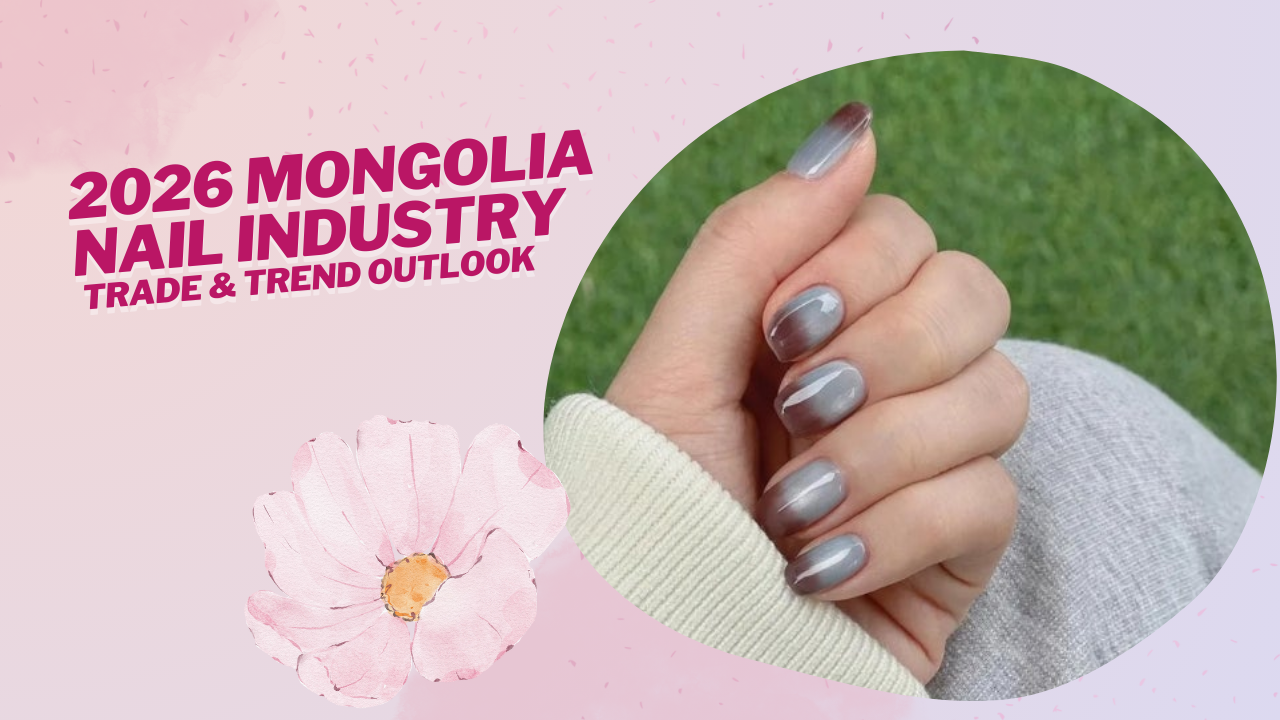
Historically, nail art in Mongolia centered around birthdays, weddings, or holiday celebrations. However, by 2026, a visible shift toward minimalist aesthetics has taken place. Neutral tones, soft gradients, and “clean” natural finishes now dominate salon portfolios.
This trend aligns with broader Asian beauty influences. Korean and Japanese minimalist styles, widely viewed online, shape local design preferences. Moreover, overseas Mongolians returning for holidays often request subtle, refined designs, reinforcing this direction.
Therefore, the Mongolia Nail Market reflects both cultural exchange and practical adaptation. Rather than bold decorative art, consumers increasingly seek designs that integrate smoothly into daily life.
Import Trends Shaping the Mongolia Nail Market
Five-Year Import Performance
Trade statistics from the Mongolia Customs Authority show that nail-related product imports rose approximately 15% between 2020 and 2024. After peaking in 2022, imports adjusted downward slightly before recovering again in 2024.
This fluctuation indicates demand sensitivity to broader economic conditions. However, the overall upward trend suggests sustained interest rather than temporary post-pandemic rebound.
Therefore, import performance supports the view that the Mongolia Nail Market is stabilizing rather than overheating.
(Unit: US$)
| Category | 2020 | 2021 | 2022 | 2023 | 2024 | 5-Year Total |
| Total Imports | 267,782 | 255,109 (-21.4%) | 347,415 (+36.1%) | 247,448 (-28.7%) | 308,926 (+24.8%) | 1,426,680 |
| China | 20,394 | 45,498 | 67,487 | 54,490 | 40,393 | 228,263 |
| Poland | 22,538 | 25,393 | 48,973 | 17,586 | 67,053 | 181,543 |
| Korea | 12,797 | 30,981 | 53,130 | 28,533 | 54,424 | 179,866 |
| Türkiye | 24,011 | 32,040 | 47,079 | 22,474 | 42,609 | 168,213 |
| Russia | 77,562 | 30,077 | 14,940 | 8,785 | 11,937 | 143,301 |
| France | 29,257 | 32,790 | 31,921 | 31,900 | 13,525 | 139,393 |
| Germany | 6,236 | 29,812 | 26,049 | 28,418 | 37,801 | 128,317 |
| United States | 53,858 | 1,039 | 14,010 | 16,797 | 14,219 | 99,922 |
| Japan | 214 | 707 | 19,439 | 19,739 | 9,309 | 49,409 |
| Luxembourg | 4,304 | 9,325 | 5,497 | 3,858 | 995 | 23,978 |
<Source: Mongolia Customs Authority>
Diversification of Supplying Countries
China remains the largest supplier in cumulative five-year value terms. Nevertheless, the sourcing structure has diversified. Poland, Korea, Türkiye, and Germany have all expanded their presence.
Import data also shows that Korean-origin products recorded particularly strong growth during the period. While absolute volumes remain moderate compared to China, growth rates suggest expanding consumer trust in Korean formulations.
This diversification signals a maturing Mongolia Nail Market. Instead of relying exclusively on low-cost supply, distributors increasingly balance price, brand reputation, and perceived safety.
Korean Products and Quality Perception
Industry interviews indicate that Korean nail products are often associated with reliability and trend leadership. Although price remains important, some mid-tier salons have begun testing Korean gel systems to differentiate service quality.
At the same time, bulk purchasing remains limited because most Mongolian distributors operate on small inventories. Consequently, exporters considering the Mongolia Nail Market must prioritize flexible shipment sizes and gradual entry strategies.
Importantly, this shift toward quality does not replace price sensitivity. Instead, it introduces segmentation within the Mongolia Nail Market, where premium and mid-tier differentiation becomes clearer.
Industry Segmentation within the Mongolia Nail Market
Premium Studios
Premium nail studios operate mainly in central Ulaanbaatar. These studios typically charge between USD 23 and 30 per service. They emphasize original design, highly trained artists, and curated product selection.
Moreover, they actively invest in social media branding. Their clientele consists largely of higher-income professionals and influencers. Although this segment remains small, it sets aesthetic direction for the broader Mongolia Nail Market.
Mid-Tier Salons
Mid-tier salons charge approximately USD 15 to 20 per service. This segment serves office workers and young professionals. Quality is consistent, and service variety remains wide.
Because this segment captures the largest share of regular consumers, it defines the structural core of the Mongolia Nail Market. Furthermore, mid-tier operators frequently experiment with imported gel systems to enhance service durability.
Entry-Level and Training Studios
Entry-level salons charge between USD 8 and 10. These studios often serve students or operate as training environments. Although margins are narrow, they provide an entry pathway for aspiring technicians.
While price competition is strongest here, this segment also feeds talent into higher tiers. Therefore, it plays a foundational role in workforce development within the Mongolia Nail Market.
Sustainability and Health Trends in the Mongolia Nail Market
Rise of Non-Toxic and Vegan Formulations
Sustainability has become a visible theme by 2026. Consumers increasingly inquire about product safety, ingredient transparency, and reduced chemical odor.
As awareness grows, some salons now advertise non-toxic or vegan gel systems. Although demand remains concentrated among higher-income consumers, momentum is building.
Consequently, the Mongolia Nail Market is beginning to align with global clean beauty standards.
Minimalism as a Lifestyle Indicator
Minimal design preference reflects more than aesthetics. It also indicates lifestyle values emphasizing simplicity and practicality. Consumers now associate understated designs with professionalism and versatility. Therefore, minimalism reinforces sustainability indirectly. Fewer decorative elements often require fewer materials and less frequent reapplication, reducing waste.
Value Shift from Price to Lifestyle Alignment
While affordability still matters, value perception has shifted. Some consumers are willing to pay slightly higher prices for better product safety or brand credibility.
However, this shift remains gradual rather than abrupt. The Mongolia Nail Market therefore presents a hybrid model where affordability coexists with selective premiumization.
Expert Commentary from Ulaanbaatar Operators
According to a small nail studio operator in central Ulaanbaatar, Korean-style clean designs are among the most requested looks in 2026. Customers frequently bring reference photos from social media platforms.
Moreover, digital marketing has overtaken physical storefront presence in importance. Many new clients discover salons exclusively through Instagram pages.
The operator also noted growing interest in Korean-made gel products. Although Chinese products remain dominant due to cost advantages, some consumers actively request alternatives.
This insight highlights the dual nature of the Mongolia Nail Market: cost-conscious yet increasingly quality-aware.
Strategic Outlook for the Mongolia Nail Market in 2026
The Mongolia Nail Market remains relatively small in absolute size. Nevertheless, its trajectory suggests gradual sophistication. Import diversification, segment clarity, and sustainability awareness collectively point toward structural normalization.
However, several constraints remain. Market scale limits economies of scale, and distributor size restricts large-volume imports. Therefore, suppliers entering this market must adopt incremental strategies.
Additionally, consumer education regarding ingredient safety may expand in coming years. If so, demand for higher-specification gel systems could strengthen further.
Meanwhile, digital branding will likely intensify competition. Salons that invest in visual identity and consistent online engagement will maintain advantage.
Overall, the Mongolia Nail Market in 2026 demonstrates stability rather than explosive growth. Yet stability itself signals resilience in a small but evolving industry.
Comparative Position within Regional Beauty Trade
Compared to larger Asian beauty markets, Mongolia’s scale remains modest. However, geographic proximity to Korea and China ensures steady product inflow.
Furthermore, reports from KOTRA have previously noted Mongolia’s increasing openness to diversified beauty imports. This observation aligns with current import statistics.
Therefore, while the Mongolia Nail Market does not yet represent a high-volume export destination, it functions as a testbed for smaller-scale brand introduction strategies.
Long-Term Implications for Industry Stakeholders
Looking beyond 2026, three trends may shape the Mongolia Nail Market:
- Continued segmentation refinement
- Increased sustainability awareness
- Stronger integration with Asian design influence
If these patterns continue, the market may shift gradually toward higher standardization and certification awareness. However, rapid consolidation appears unlikely due to the predominance of small independent salons.
Thus, evolution rather than disruption defines the Mongolia Nail Market outlook.
Insights: Structural Maturity in Progress
The Mongolia Nail Market in 2026 reflects a transition phase. Durability-driven demand, minimalist design preference, import diversification, and early sustainability signals collectively illustrate gradual maturation.
Importantly, the sector’s development remains grounded in realistic consumer purchasing power. Instead of rapid expansion, steady normalization characterizes growth.
Therefore, observers should interpret current trends as indicators of long-term structural stability rather than short-term hype. The Mongolia Nail Market stands at an inflection point where quality awareness and practical affordability intersect.
Related Reports
Russia Nail Services Market Trends
Brazil Nail Care Market analysis 2026
Method & Source Notes
This report is based on official trade statistics from the Mongolia Customs Authority, publicly available company data, and interviews with local nail studio operators in Ulaanbaatar. Import figures were reorganized for analytical reporting purposes. Market segmentation data reflects observed pricing ranges from salon listings and social media portfolios.
All content has been independently written and structured for journalistic analysis. No direct commercial promotion or product endorsement is included.
Editorial Disclaimer
This article is for informational and analytical purposes only. It does not promote specific brands or products. Market observations reflect available data and industry interviews as of early 2026.
Advertising Disclosure
Advertisements on this page are automatically served by Google AdSense and are not associated with affiliate or sponsored content.