
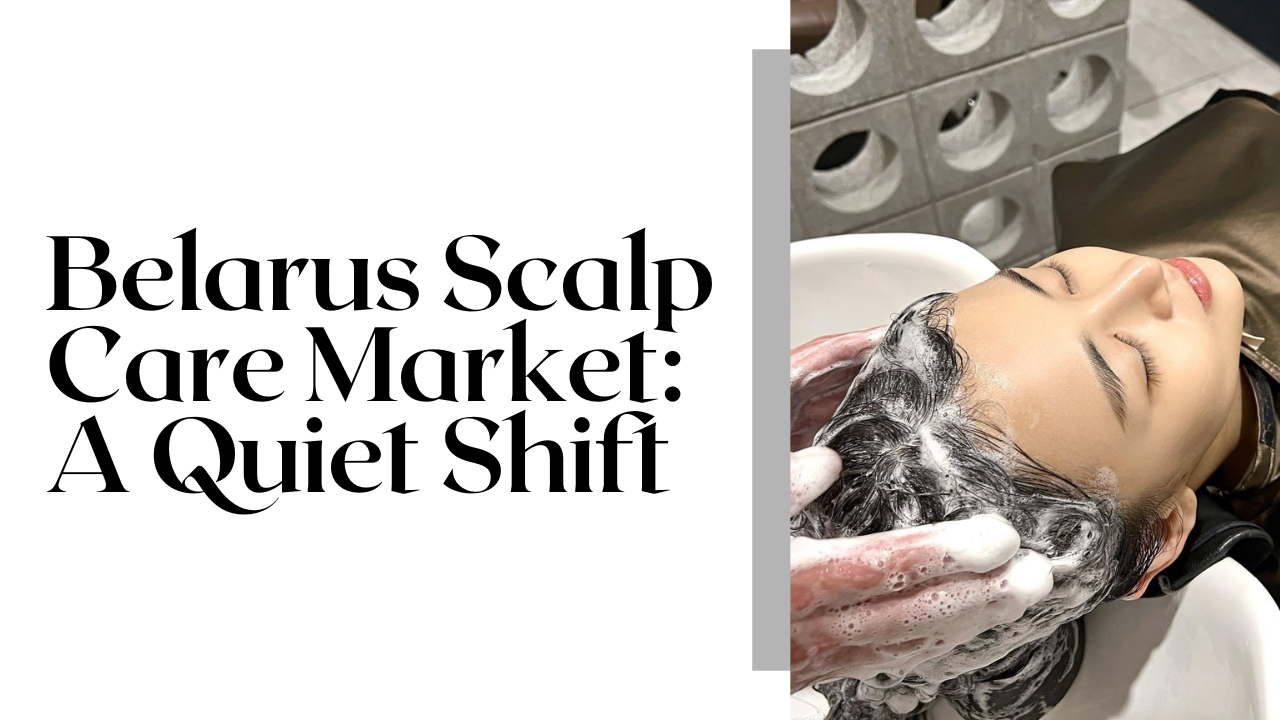
Author: John Lee – Independent Market Analyst specializing in Eastern European beauty and personal care markets, with a research focus on the Belarus Scalp Care Market.
Overview of the Belarus Scalp Care Market
The Belarus Scalp Care Market has entered a phase of gradual but structurally meaningful growth. While the market remains largely dominated by mass‑market hair care products, recent years have shown a clear transition toward scalp‑focused and problem‑solving solutions. This shift reflects broader changes in consumer awareness, ingredient sensitivity, and product specialization.
According to industry estimates, the broader hair and scalp care sector in Belarus reached approximately USD 73 million in 2024 and is projected to expand steadily through 2029. Although overall growth rates remain moderate, the internal composition of the market is changing more rapidly than topline figures suggest.

<Source: Euromonitor International; compiled by Author>
Market Size and Growth Outlook
From a quantitative perspective, the Belarus Scalp Care Market is closely tied to the national hair care category, which has maintained annual growth in the low‑to‑mid single digits. Market researchers project that total hair and scalp care consumption will continue expanding through the end of the decade, supported by stable household demand and incremental premiumization.
However, growth is not evenly distributed across product types. While conventional shampoos remain the largest category by volume, scalp‑specific products—such as anti‑dandruff treatments, sensitive scalp solutions, and repair‑focused formulations—are gaining a higher share of consumer spending.
Consumer Behavior and Demand Shifts
A defining feature of the Belarus Scalp Care Market is the gradual evolution of consumer expectations. Belarusian consumers have traditionally favored affordable, widely available products. Recently, however, purchasing decisions are increasingly influenced by functional claims and ingredient transparency.
In particular, demand is rising for products addressing:
- Sensitive or irritated scalp conditions
- Excess oil or dryness imbalance
- Hair thinning and scalp strengthening
- Damage caused by environmental stress and frequent styling
As a result, consumers are moving away from one‑size‑fits‑all shampoos toward more targeted scalp care solutions designed for specific concerns.
Ingredient Trends in Scalp Care Products
Ingredient awareness has become a critical driver in the Belarus Scalp Care Market. Shoppers are paying closer attention to formulation details, especially the exclusion of sulfates and parabens. Products positioned around plant‑based extracts, amino acid complexes, ceramides, and moisturizing agents are increasingly favored.
This shift mirrors global clean‑beauty tendencies, but it also reflects local sensitivity to scalp health, particularly in colder climates where dryness and irritation are common concerns. Consequently, functional and mild formulations are becoming a baseline expectation rather than a premium feature.
Import Structure and Trade Environment
Trade dynamics play a central role in shaping the Belarus Scalp Care Market. Since 2022, detailed foreign trade statistics published by Belarusian authorities have been limited. Nevertheless, international trade databases indicate that Belarus continues to rely heavily on imported hair and scalp care products.
European suppliers—particularly Lithuania, Poland, Italy, and Türkiye—remain prominent. At the same time, Russia is widely regarded as the largest de facto supplier, accounting for an estimated 70–80% of total imports when indirect flows are considered.
Unit: US$ thousand
| Rank | 2022 Country | 2022 Value | 2023 Country | 2023 Value | 2024 Country | 2024 Value |
| — | Total (Reporting Countries) | 17,273 | Total (Reporting Countries) | 17,421 | Total (Reporting Countries) | 14,550 |
| 1 | Poland | 2,711 | Lithuania | 2,335 | Lithuania | 1,353 |
| 2 | Türkiye | 2,129 | Poland | 1,609 | Poland | 1,107 |
| 3 | Lithuania | 1,297 | Türkiye | 1,115 | Italy | 1,088 |
| 4 | Italy | 641 | Italy | 955 | Türkiye | 1,030 |
| 5 | South Korea | 366 | South Korea | 621 | South Korea | 853 |
| 6 | Hungary | 217 | France | 465 | France | 497 |
| 7 | France | 180 | Spain | 220 | Latvia | 170 |
| 8 | Spain | 128 | Hungary | 198 | Spain | 159 |
| 9 | United Kingdom | 94 | Latvia | 165 | Estonia | 100 |
| 10 | Latvia | 69 | Germany | 83 | Kazakhstan | 97 |
<Source: Global Trade Atlas on April 2025; compiled by Author>
Position of Korean Scalp Care Products
Within this import landscape, Korean scalp care products have shown consistent growth. Although their absolute market share remains relatively small, Korean suppliers have recorded strong year‑on‑year increases, especially in shampoos and specialized scalp treatments.
The appeal of Korean products lies primarily in their reputation for functional formulations and ingredient‑focused development. In the Belarus Scalp Care Market, Korean brands are increasingly associated with:
- Scalp‑specific solutions rather than general hair care
- Mild yet performance‑oriented formulations
- Premium but accessible positioning
This perception provides Korean suppliers with a strategic opening despite intense competition from multinational brands.
Competitive Landscape
The competitive structure of the Belarus Scalp Care Market is highly concentrated. Multinational corporations control more than half of total market share, with strong brand recognition and established distribution channels.
At the same time, domestic manufacturers maintain a meaningful presence by offering competitively priced alternatives. These local brands benefit from consumer familiarity and cost advantages, particularly in mass‑market segments.
Korean brands operate primarily in the mid‑range and specialized niches, where differentiation through formulation and functionality is more achievable than direct price competition.
Distribution Channels and Retail Dynamics
Scalp care products in Belarus are distributed through a combination of large retail chains, pharmacies, beauty specialty stores, and professional salons. In recent years, online retail has gained importance, allowing consumers to access a wider range of international brands.
This diversification of channels has lowered entry barriers for niche scalp care products while intensifying competition across all price segments. Effective product positioning and clear functional messaging have therefore become increasingly important.

<Source: Image taken by Author>
Tariffs, Import Regulations, and Certification Requirements
Hair care and scalp care products imported into Belarus are subject to the unified customs and regulatory framework of the Eurasian Economic Union (EAEU). Products classified under HS codes 330510, 330530, and 330590 are subject to a 6.5% import duty, which applies uniformly across EAEU member states, including Russia, Kazakhstan, Armenia, and Kyrgyzstan.
In addition to customs duties, imported hair care products are subject to a 20% value-added tax (VAT) in Belarus. These fiscal conditions form the baseline cost structure for foreign suppliers entering the Belarusian market.
From a regulatory perspective, hair and scalp care products must comply with EAEU cosmetic safety requirements. Importers are required to obtain a Declaration of Conformity, while products intended for infants are subject to State Registration procedures. All compliant products must carry the EAC conformity mark, indicating adherence to EAEU technical regulations.
For shampoos and related hair care products, the primary regulatory framework is TR CU 009/2011, which governs the safety of perfumery and cosmetic products within the EAEU. Compliance with this regulation is a prerequisite for customs clearance and legal distribution in the Belarusian market.
Market Implications and Outlook
Looking ahead, the Belarus Scalp Care Market is expected to remain stable rather than explosive. Nevertheless, structural opportunities exist for suppliers offering targeted, ingredient‑driven scalp solutions.
As multinational brands focus on scale and local players compete on price, differentiated products—especially those emphasizing scalp health, gentle formulations, and functional benefits—are likely to gain incremental traction.
Key Beauty Industry Exhibition in Belarus
One of the most effective channels for tracking emerging trends in the Belarus Scalp Care Market is the domestic beauty exhibition ecosystem. In particular, the InterStyle exhibition in Minsk functions as a key observation point for shifts in product positioning, buyer demand, and supplier strategies within the Belarusian beauty industry.
| Item | Description |
| Exhibition Name | InterStyle |
| Exhibition Profile | The only specialized beauty and cosmetics trade exhibition held regularly in Belarus |
| Industry Scope | Hair care, scalp care, skincare, and related beauty product segments |
| Primary Function | Observation of market trends, buyer demand, and supplier positioning within the Belarusian beauty industry |
| Schedule | Annually in November (November 5–8) |
| Venue | Football Arena, Minsk (Pobediteley Ave., 20/2) |
| Key Participants | Local manufacturers, importers, distributors, international brands, and professional buyers |
| Market Significance | Provides on-the-ground insight into evolving demand patterns and competitive dynamics in the Belarusian beauty market |
Read More
Brazil Haircare Products Market
Method & Source Notes
This report is based on a synthesis of international market research, trade statistics, and publicly available industry data. Primary sources include international trade databases, global market research firms, and materials compiled by overseas trade offices. Due to partial limitations in official Belarusian trade disclosures since 2022, some import figures are estimates derived from secondary data.
Editorial Disclaimer
This article is intended for informational and analytical purposes only. It does not constitute commercial advice or product endorsement. Market conditions may change, and readers are encouraged to consult multiple sources when making decisions.
Advertising Disclosure
Advertisements on this page are automatically served by Google AdSense and are not associated with affiliate or sponsored content.